Granular Chlorine
Keep Your Swimming Pool Sanitized, Kill Bacteria and Algae, Perform Shock Treatments
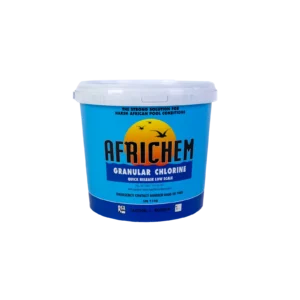
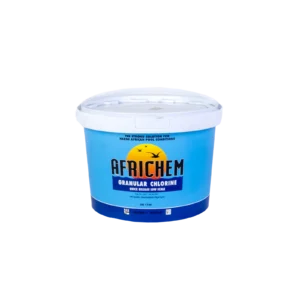
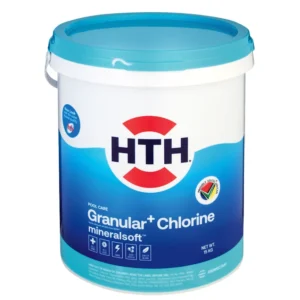
Granular chlorine offers a fast-acting, quick-dissolving solution for sanitizing swimming pool water. It remains the go-to product for South African pool owners to do routine sanitation and shock treatments.
Our Chlorine Options
We have various types of granular chlorine suitable for all types of swimming pool requirements.
Our Granular Chlorine Solutions
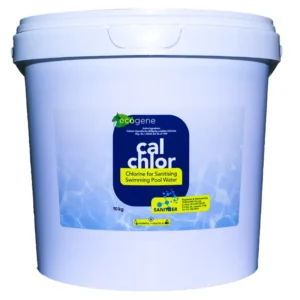
ecogene CalChlor Granular Chlorine – 10Kg
Frequently Asked Questions
How should I apply granular chlorine?
The recommended method is to add the required dose of granular chlorine directly into the pool's weir (skimmer) without pre-dissolving it, so the circulating water distributes it through the pool. Avoid spreading granules across the pool surface: this can release chlorine dust that may be inhaled, and granules that settle in one concentrated spot can damage or bleach the pool surface. Add chlorine while the pump is running, ideally in the evening when sunlight breaks it down less.
How much chlorine is needed for my pool?
Residential swimming pools need a chlorine level of 1 to 3 PPM (parts per million) to stay properly sanitised. As a general guide, that means approximately 250g of calcium hypochlorite (such as Cal-Chlor) or 165g of sodium dichloroisocyanurate (such as Pro-Chlor), three times per week. The exact amount depends on pool size, weather and how much the pool is used, so test the water with a pool testing kit and adjust the dose to the reading. Hyper Pool Group branches also offer free water testing.
What is the difference between Di-Chlor and Cal-Hypo granules?
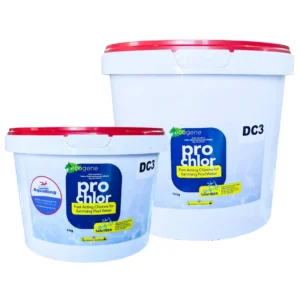
Di-Chlor (sodium dichloroisocyanurate, sold as Pro-Chlor) is a fast- and clear-dissolving stabilised chlorine, meaning it contains added protection against breakdown by the sun. It is well suited to pool water with high calcium hardness. Cal-Hypo (calcium hypochlorite, sold as Cal-Chlor) typically delivers 60% to 70% available chlorine and contains no stabiliser, so it does not raise the cyanuric acid level of the pool water. The better choice depends on the pool's stabiliser and calcium levels.
Why does my pool require a chlorine shock?
A chlorine shock removes chloramines, often called dead chlorine. Chloramines form when chlorine combines with swimmer waste such as sweat and sunscreen, and with debris washed in by rainstorms; they cause strong chlorine smells and eye irritation while sanitising poorly. Shocking also quickly raises chlorine to the required level, for example when a chlorine floater has run empty, so the refilled floater can maintain it. Shock treatments also help clear algae outbreaks.
When can I swim after adding chlorine or shocking my pool?
It is safe to swim once chlorine has returned to 3 PPM or lower, which is the ideal level for bather comfort. After a shock treatment, let the water circulate through the filter for a few hours, then test the chlorine level before anyone swims. High-dose shocks may need longer, often overnight. Chlorine levels can be checked with a DIY pool water testing kit, and Hyper Pool Group branches also offer free water testing.
Does chlorine kill algae?
Yes. Chlorine is an oxidiser that breaks down and destroys algae, and keeping the available chlorine level between 1 and 3 PPM controls everyday algae growth. Established or heavy algae outbreaks are harder to clear with chlorine alone, because algae can consume chlorine faster than a normal dose supplies it. For heavy infestations, the recommended approach is a chlorine shock combined with an algae killer, together with brushing and extended filtration.