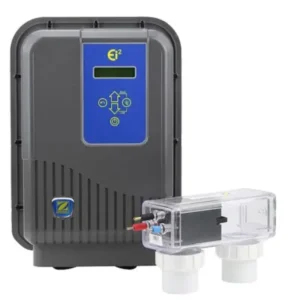
Crystal-clear water with automated pool sanitisation.
Take the guesswork out of pool maintenance with a pool chlorine generator. Also known as a salt chlorinator, a chlorinator automatically converts dissolved pool salt into chlorine, providing a continuous and effective sanitising solution for your swimming pool.
At Hyper Pool Group, we offer reliable chlorine generators designed to keep your pool water clean, clear, and healthy while reducing the need for manual chlorine dosing.
How it works
Why Choose a Salt Chlorinator?
A pool chlorinator uses electrolysis to convert salt dissolved in your pool water into chlorine. This continuously sanitises the water, helping to control bacteria, algae and other contaminants while maintaining consistent water quality.
Lower Chemical Handling
Reduce the need to store and manually add chlorine products to your pool.
Reduced Maintenance
Automated chlorine generation helps simplify pool care and reduces ongoing maintenance requirements.
Cost-effective Operation
Once installed, chlorine generators can help reduce long-term chemical costs compared to traditional chlorine dosing.
A pool chlorine generator, also known as a salt chlorinator, produces chlorine from salt dissolved in the pool water. As water flows through the chlorinator cell, an electrical current converts the salt into chlorine through a process called electrolysis. The chlorine sanitises the water and then reverts to salt, so the salt is reused. This keeps the pool sanitised automatically, without adding chlorine by hand every few days.
Do I still need to add chlorine to a pool with a salt chlorinator?
In most cases, a correctly sized and set salt chlorinator produces enough chlorine for everyday sanitisation, so regular chlorine dosing is not needed. However, occasional shock treatments may still be required after heavy pool use, storms or algae outbreaks, when chlorine demand rises faster than the chlorinator can supply. Test chlorine levels regularly; if they stay low, increase the chlorinator's output or run time, or check the salt level.
Does a chlorine generator make pool water salty?
Only slightly. A salt-chlorinated pool contains a much lower salt concentration than seawater, roughly a tenth or less, so most swimmers barely taste the salt. Many people find salt-chlorinated pools feel softer and more comfortable on the skin and eyes than pools dosed with chlorine by hand. The recommended salt level depends on the chlorinator model and is listed in its specifications.
How often will I need to add salt to a saltwater pool?
Salt is not used up by a salt chlorinator, because the chlorine it produces reverts to salt after sanitising the water. Salt is only lost when water leaves the pool, through splash-out, backwashing, leaks, or dilution from heavy rainfall and top-ups. Check salt levels regularly, for example monthly and after heavy rain, and top up when the reading falls below the chlorinator's recommended range. Many chlorinators also display a low-salt warning.
Do salt chlorinators require maintenance?
Yes. Salt chlorinators need routine maintenance to keep producing chlorine efficiently. This includes checking salt levels, keeping pH in range, and periodically inspecting and cleaning the chlorinator cell to remove calcium build-up (scale), which reduces chlorine output. Cells are usually cleaned with a mild acid solution following the manufacturer's instructions. Some models have a self-cleaning reverse-polarity function, but they still need occasional inspection.
How do I choose the right salt chlorinator for my pool?
The right salt chlorinator depends on the pool's water volume, how much it is used and environmental conditions such as climate and sun exposure. Chlorinators are rated by how much chlorine they can produce, so choose a unit rated for the pool's volume, with some extra capacity for hot weather and heavy use. Also consider features such as pH control modules and self-cleaning cells, and how easily replacement cells and parts can be found.